Reduction of the Survival of the Soilborne Pathogen Phytophthora palmivora on Theobroma cacao Pods Through the Application of Trichoderma spp.
DOI:
https://doi.org/10.28940/terralatinoamericana.v44i.2435Keywords:
antagonism, biocontrol, infection, inoculum, zoosporesAbstract
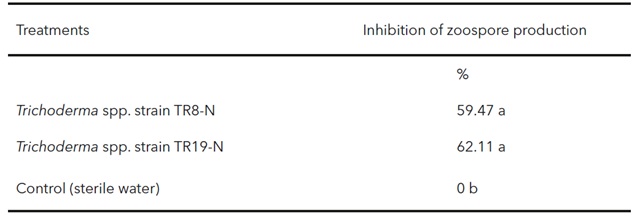
In Ecuador, Phytophthora palmivora is an important pathogen af fecting the cultivation of Theobroma cacao. The survival of this microorganism depends largely on its ability to reproduce in pods lef t on the soil. This study evaluated fourteen native isolates of Trichoderma spp. with the aim of reducing the pathogen’s survival and thereby decreasing the potential inoculum present in the soil. The research was conducted in the Microbiology area of the Rumiología laboratory at the Universidad Técnica Estatal de Quevedo (Ecuador). Trichoderma and P. palmivora strains were obtained from institutional collections and cultured on Potato Dextrose Agar and V8 Juice Agar media, respectively. Dual cultures of biocontrol agents and the pathogen were performed to calculate the pathogen’s growth inhibition percentage. Additionally, the isolates were classified according to their antagonistic activity using standard scales. The two best-performing biocontrol strains were selected to conduct pod assays to evaluate their ef fect on infection and reproduction of artificially inoculated P. palmivora. Moreover, the impact of these strains on the reproductive capacity of the pathogen was assessed in naturally infected pods. Strains TR8-N and TR19-N demonstrated superior results, exhibiting over 90% inhibition and high antagonistic capacity. Microscopic observations revealed alterations in pathogen hyphae and evidence of mycoparasitism. In pod assays, those treated with TR8-N showed no symptoms following artificial pathogen inoculation. Both TR19-N and TR8-N reduced pathogen inoculum production on the surface of naturally infected pods. These results indicate that at least two native isolates evaluated could be applied on af fected pods to reduce pathogen inoculum in cacao cultivation soils.
Downloads
References
Alfiky, A., Abou-Mansour, E., De Vrieze, M., Haridon, F. L., & Weisskopf, L. (2024). Newly Isolated Trichoderma spp. Show Multifaceted Biocontrol Strategies to Inhibit Potato Late Blight Causal Agent Phytophthora infestans both In Vitro and In Planta. Phytobiomes Journal, 8(1), 70–84. https://doi.org/10.1094/PBIOMES-01-23-0002-R
Ben M’henni, Y., Salem, I. Ben, Souli, M., Tounsi, S., Debieu, D., Fillinger, S., & Boughalleb-M’hamdi, N. (2022). Biocontrol and Growth Promotion Potential of Combined Application of Trichoderma simmonsii and Aspergillus westerdijkiae Against Apple Tree Dieback Disease. PhytoFrontiersTM, 2(3), 268–279. https://doi.org/10.1094/PHYTOFR-01-22-0005-R
Carella, P., Gogleva, A., Tomaselli, M., Alfs, C., & Schornack, S. (2018). Phytophthora palmivora establishes tissue-specific intracellular infection structures in the earliest divergent land plant lineage. Proceedings of the National Academy of Sciences of the United States of America, 115(16), E3846–E3855. https://doi.org/10.1073/pnas.1717900115
Guerrero, R., Palma, R. P., Cevallos, O., & Mónaco, C. (2025). Effect of Native Trichoderma Strains on Moniliophthora roreri Infection in Theobroma cacao L. Revista De Gestão - RGSA, 19(2), e011357. https://doi.org/10.24857/rgsa.v19n2-087
Harman, G. E. (2006). Overview of mechanisms and uses of Trichoderma spp. Phytopathology, 96(2), 190–194. https://doi.org/10.1094/PHYTO-96-0190
Herrera-Téllez, V. I., Cruz-Olmedo, A. K., Plasencia, J., Gavilanes-Ruíz, M., Arce-Cervantes, O., Hernández-León, S., & Saucedo-García, M. (2019). The protective effect of Trichoderma asperellum on tomato plants against Fusarium oxysporum and Botrytis cinerea diseases involves inhibition of reactive oxygen species production. International Journal of Molecular Sciences, 20(8), 1–13. https://doi.org/10.3390/ijms20082007
Kongor, J. E., Owusu, M., & Oduro-Yeboah, C. (2024). Cocoa production in the 2020s: challenges and solutions. CABI Agriculture and Bioscience, 5(1), 102. https://doi.org/10.1186/s43170-024-00310-6
Kubicek, C., & Harman, G. (2002). Trichoderma and Gliocladium. Taylor & Francis.
Legavre, T., Ducamp, M., Sabau, X., Argout, X., Fouet, O., Dedieu, F., Surujdeo-Maharaj, S., Garcia, D., Paulin, D., & Lanaud, C. (2015). Identification of Theobroma cacao genes differentially expressed during Phytophthora megakarya infection. Physiological and Molecular Plant Pathology, 92, 1–13. https://doi.org/https://doi.org/10.1016/j.pmpp.2015.08.005
Manzar, N., Kashyap, A. S., Goutam, R. S., Rajawat, M. V. S., Sharma, P. K., Sharma, S. K., & Singh, H. V. (2022). Trichoderma: Advent of Versatile Biocontrol Agent, Its Secrets and Insights into Mechanism of Biocontrol Potential. In Sustainability (Switzerland) (Vol. 14, Issue 19). MDPI. https://doi.org/10.3390/su141912786
Mohamed, A. I. N. A., Sundram, S., & Ramachandran, V. (2019). Pathogenicity of Malaysian Phytophthora palmivora on cocoa, durian, rubber and oil palm determines the threat of bud rot disease. Forest Pathology, 49(6). https://doi.org/10.1111/efp.12557
Nascimento, V. C., Rodrigues-Santos, K. C., Carvalho-Alencar, K. L., Castro, M. B., Kruger, R. H., & Lopes, F. A. C. (2022). Trichoderma: biological control efficiency and perspectives for the Brazilian Midwest states and Tocantins. Brazilian Journal of Biology, 82. https://doi.org/10.1590/1519-6984.260161
Ndoungué, D., Minette, M., Bieng, M. A. N., Ribeyre, F., Bonnot, F., Cilas, C., Neema, C., & ten Hoopen, G. M. (2021). Spatial and temporal analysis of Phytophthora megakarya epidemic in newly established cacao plantations. Plant Disease, 105(5). https://doi.org/10.1094/PDIS-09-19-2024-RE
Osorio, Z. M. A., Castillo, D. A., Rodríguez, P. L., & Terán, W. (2021). Cacao (Theobroma cacao L.) Response to Water Stress: Physiological Characterization and Antioxidant Gene Expression Profiling in Commercial Clones. Frontiers in Plant Science, 12. https://doi.org/10.3389/fpls.2021.700855
Paredes, N., Monteros-Altamirano, Á., Lima, L., Caicedo, C., Bastidas, S., & Tinoco, L. (2022). Manual del cultivo de cacao sostenible para la Amazonía ecuatoriana (1st ed.). Ministerio de Agricultura y Ganadería.
Perrine-Walker, F. (2020). Phytophthora palmivora–cocoa interaction. Journal of Fungi, 6(3), 1–20. https://doi.org/10.3390/jof6030167
Prismantoro, D., Jefferson, T. A., Akbari, S. I., Miranti, M., Mispan, M. S., & Doni, F. (2024). In vitro inhibition mechanisms of Trichoderma yunnanense TM10 against Pyricularia oryzae and Rhizoctonia solani causing blast and sheath blight diseases in rice (Oryza sativa L.). All Life, 17(1). https://doi.org/10.1080/26895293.2024.2422845
Salous, E., García, M., Javier, J., Vargas, G., Andrea, J., Alcivar, M., & Roberto, F. (2020). Mejoramiento de la calidad del cultivo de cacao en Ecuador. Revista Venezolana de Gerencia, 3, 368–380.
Sarria, G., Garcia, A., Mestizo, Y., Medina, C., Varón, F., Mesa, E., & Hernandez, S. (2021). Antagonistic interations between Trichoderma spp. and Phytophthora palmivora (Butler) from oil palm in COLOMBIA. European Journal of Plant Pathology, 161(4), 751–768. https://doi.org/10.1007/s10658-021-02363-z
Sharma, B. L., Singh, S. P., & Sharma, M. L. (2012). Bio-degradation of Crop Residues by Trichoderma Species vis-à vis Nutrient Quality of the Prepared Compost. Sugar Tech, 14(2), 174–180. https://doi.org/10.1007/s12355-011-0125-x
Sofiana, F. D., Kuswinanti, T., Rosmana, A., & Ubaidillah, A. (2025). Trichoderma spp. as biocontrol agent against cocoa fruit rot disease: An exploration from Ambon Island, Maluku. IOP Conference Series: Earth and Environmental Science, 1469(1). https://doi.org/10.1088/1755-1315/1469/1/012018
Solis, H. K., Peñaherrera, V. S., & Vera, C. D. (2021). GUÍA No. 178 Las enfermedades del cacao y las buenas prácticas agronómicas para su manejo (INIAP). https://repositorio.iniap.gob.ec/handle/41000/5747
Sood, M., Kapoor, D., Kumar, V., Sheteiwy, M. S., Ramakrishnan, M., Landi, M., Araniti, F., & Sharma, A. (2020). Trichoderma: The “secrets” of a multitalented biocontrol agent. In Plants (Vol. 9, Issue 6, pp. 1–25). MDPI AG. https://doi.org/10.3390/plants9060762
Surujdeo-Maharaj, S., Sreenivasan, T., Motilal, L., & Umaharan, P. (2016). Black Pod and Other Phytophthora Induced Diseases of Cacao: History, Biology, and Control. 213–266. https://doi.org/10.1007/978-3-319-24789-2_7
Turaeva, B., Soliev, A., Eshboev, F., Kamolov, L., Azimova, N., Karimov, H., Zukhrritdinova, N., & Khamidova, K. (2020). The use of three fungal strains in producing of indole-3-acetic acid and gibberelllic acid. Plant Cell Biotechnology and Molecular Biology, 21, 32–43.
Wang, X., Zhao, Z., Li, H., Wei, Y., Hu, J., Yang, H., Zhou, Y., & Li, J. (2024). The growth-promoting and disease-suppressing mechanisms of Trichoderma inoculation on peanut seedlings. Frontiers in Plant Science, 15. https://doi.org/10.3389/fpls.2024.1414193
Yao, X., Guo, H., Zhang, K., Zhao, M., Ruan, J., & Chen, J. (2023). Trichoderma and its role in biological control of plant fungal and nematode disease. Frontiers in Microbiology, 14(May), 1–15. https://doi.org/10.3389/fmicb.2023.1160551
Youassi, Y. O. Y., Ambata, H. T. A., Jiogue, M. B., Dikongue, F. J. N., Ayong, M. N. A., Bedine, M. A. B., Tchameni, S. N., & Sameza, M. L. (2024). The potential of Trichoderma asperellum organic extract and its emulsion to inhibit cocoa (Theobroma cacao L.) black pod disease and induce biochemical defenses against Phytophthora megakarya. Journal of Plant Protection Research, 64(1), 19–28. https://doi.org/10.24425/jppr.2024.149159
Zambrano, J. L. (2018). Diagnóstico de estado del arte de la cadena de valor de cacao en América Latina y El Caribe (FONTAGRO).