Metagenomic Analysis of Microbial Communities in the Anaerobic Biodigestion of Cattle Manure: Biotechnological Implications for the Bioremediation of Contaminated Soils
DOI:
https://doi.org/10.28940/terralatinoamericana.v44i.2436Keywords:
bacteria, biodigesters, digestate, methanogenesisAbstract
Anaerobic digestion is a key biotechnological tool for energy recovery and the sustainable management of livestock waste, generating biogas and biofertilizers that reduce greenhouse gas emissions. The objective of this study was to
analyze the microbial communities present during the anaerobic biodigestion of cattle
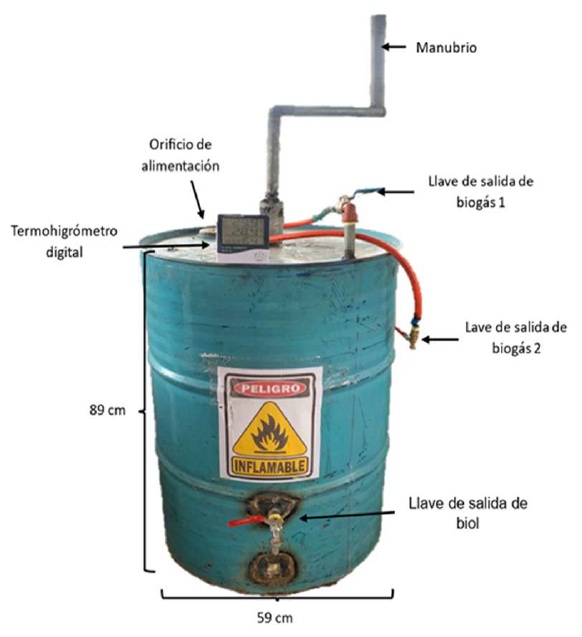
manure through metagenomic sequencing, evaluating their potential for the bioremediation of contaminated soils. The research was conducted over 60 days at the Hermanos JBZ ranch in El Empalme, Ecuador, using a 200 L pilot-scale metal biodigester fed with a 1:1 mixture of manure and water and operated under controlled mesophilic conditions (30–38 °C). Three biol samples were collected (days 0, 30, and 60) for bacterial diversity analysis, applying column-based DNA extraction protocols, amplification of the 16S rRNA gene (V3–V4 regions, primers 341F/805R), and sequencing using the Illumina platform. The data were processed using bioinformatic tools for taxonomic annotation and determination of the relative abundance of genera. The results revealed a microbial succession typical of anaerobic processes, with an initial predominance of fermentative bacteria such as Bacteroides (4.11%) and Lysinibacillus, followed by Treponema (8.97%) and methanogenic archaea (Methanocorpusculum, Methanosarcina, Methanobrevibacter) in the final phase. These communities demonstrated complementary functions in organic matter degradation, methane production, carbon stabilization, and potential metal immobilization. Although the application of digestate was not experimentally evaluated, the integration of metagenomic data with recent literature supports its value as a microbial bioamendment. Overall, the results provide scientific evidence on the usefulness of microbial consortia from biodigesters as soil restoration agents, reinforcing the principles of the circular bioeconomy and Sustainable Development Goals 7, 12, and 13.
Downloads
References
Ayilara, M. S., Aremu, C. O., Abioye, O. P., & Akande, S. O. (2023). Bioremediation of environmental wastes: the role of microorganisms. Frontiers in Agronomy, 4, 1183691. https://doi.org/10.3389/fagro.2023.1183691
Grossi, G., Goglio, P., Vitali, A., & Williams, A. G. (2019). Livestock and climate change: Impact of livestock on climate and mitigation strategies. Animal Frontiers, 9(1), 69–76. https://doi.org/10.1093/af/vfy034
Harirchi, S., Tavakoli, M., Moravej, A., & Shokri, A. (2022). Microbiological insights into anaerobic digestion for biogas production: A review. Applied Microbiology and Biotechnology, 106, 1–17. https://doi.org/10.1080/21655979.2022.2035986
Intergovernmental Panel on Climate Change (IPCC). (2021). Climate Change 2021: The Physical Science Basis. Cambridge University Press. https://www.ipcc.ch/report/ar6/wg1/
Ostos, I., García-López, F., Hernández, A., Ramírez, J., & Cordero, J. (2024). A metagenomic approach to demystify the anaerobic digestion “black box”. Frontiers in Microbiology, 15, 1437098. https://doi.org/10.3389/fmicb.2024.1437098
Pande, V., Pandey, A., & Naik, S. N. (2022). Microbial interventions in bioremediation of heavy metal pollution. Frontiers in Microbiology, 13, 9120775. https://doi.org/10.3389/fmicb.2022.824084
Pastorelli, R., Galli, A., Fabbri, A., Tomei, F., & Schiavon, M. (2024). Effects of anaerobic digestates and biochar amendments on soil health, greenhouse gas emissions and microbial community structure. Applied Sciences, 14(5), 1917. https://doi.org/10.3390/app14051917
Kadam, R., Jo, S., Lee, J., Khanthong, K., Jang, H., & Park, J. (2024). A review on the anaerobic co-digestion of livestock manures in the context of sustainable waste management. Energies, 17(3), 546. https://doi.org/10.3390/en17030546
Sevillano, A., Gómez, C., Zuluaga, M., & Torres, J. (2021). Anaerobic digestion for producing renewable energy from high-strength organic wastes: a review. Processes, 9(12), 2021. https://doi.org/10.3390/e23020145
Aremanda, R. B., Debretsion, S., Tesfalem, S., & Menghisteab, R. (2023). Competence of Cow Manure as a Sustainable Feedstock for Bioenergy and Biofertilizer Production. International Journal on Food, Agriculture and Natural Resources, 4(2), 59–67. https://doi.org/10.46676/ij-fanres.v4i2.135
Mejía, G., & Peralta, J. (2019). Producción de biogás mediante biodigestor a escala piloto con residuos semi-sólidos (excreta y rumen) del camal de Calceta, Bolivar. https://repositorio.espam.edu.ec/bitstream/42000/1000/1/TTMA46.pdf
Lara, M. (2016). "Diseño de un biodigestor para la producción de biogás generado por las excretas de ganado vacuno, en el criadero “jersey chugllin.” http://dspace.espoch.edu.ec/bitstream/123456789/6261/1/236T0242.pdf
Ayala, S., Jijón, P., & Chacha, P. (2022). Estudio de un sistema de energía renovable para la producción de biogás a partir del estiércol de ganado en la hacienda Nueva Esperanza (Cotopaxi, Ecuador). Espacios, 43(05), 64–72. https://doi.org/10.48082/espacios-a22v43n05p05
Wang, S., Ma, F., Ma, W., Wang, P., Zhao, G., & Lu, X. (2019). Influence of Temperature on Biogas Production Efficiency and Microbial Community in a Two-Phase Anaerobic Digestion System. Water, 11(1), 133. https://doi.org/10.3390/w11010133
Giongo, A., Camila Granadas, L. B., Borges, F. J. Tridande., S. P. Mattiale., R. R. Oliviera., F. M. Shubeita., A. Lobato., C. Marcon y R.M. Silva (2020). Microbial communities in anaerobic digesters change over time fed with cattle manure. Brazilian. Journal of Microbiology, 51, 2121–2134. https://10.1007/s42770-020-00272-7
Roopnarain, A., Akindolire, M. A., Rama, H., & Ndaba, B. (2023). Casting light on the micro-organisms in digestate: Diversity and untapped potential. Fermentation, 9(2), 160. https://doi.org/10.3390/fermentation9020160
van Midden, C., Harris, J., Shaw, L., Sizmur, T., & Pawlett, M. (2023). The impact of anaerobic digestate on soil life: A review. Applied Soil Ecology, 191, 105066. https://doi.org/10.1016/j.apsoil.2023.105066
Bonet-García, N., Baldasso, V., Robin, V., Gomes, C. R., Guibaud, G., Alves, M. J., Castro, R., Mucha, A. P., & Almeida, C. M. R. (2023). Metal mobility in an anaerobic-digestate-amended soil: The role of two bioenergy crop plants and their metal phytoremediation potential. Frontiers in Environmental Science, 11, 1267463. https://doi.org/10.3389/fenvs.2023.1267463
Pérez-Bravo, S. G., Bautista-Vargas, M. E., Hernández-Sánchez, A., & Enrique-Padilla, J. (2017). Evaluación del potencial de generación de estiércol como materia prima para la producción de biogás en la Zona Altamira, Tamualipas. Revista de Sistemas Experimentales, 4(10), 34–40.
Speksnijder, D. C., Hopman, N. E. M., Kusters, N. E., Timmerman, A., Swinkels, J. M., Penterman, P. A. A., Krömker, V., Bradley, A. J., Botteldoorn, N., Gehring, R., & Zomer, A. L. (2022). Potential of ESBL-producing Escherichia coli selection in bovine feces after intramammary administration of first generation cephalosporins using in vitro experiments. Scientific Reports, 12(1), 15083. https://doi.org/10.1038/s41598-022-15558-z
Molotla Torres, D. E. (2022). Evaluación del efecto de Lactoferrina bovina sobre la abundancia de bacterias de la microbiota implicadas con la homeostasis intestinal en ratones BALB/c sometidos a estrés. Universidad Autónoma Metropolitana. Unidad Xochimilco.
Cai, M., Wilkins, D., Chen, J., Ng, S.-K., Lu, H., Jia, Y., & Lee, P. K. H. (2016). Metagenomic Reconstruction of Key Anaerobic Digestion Pathways in Municipal Sludge and Industrial Wastewater Biogas-Producing Systems. Frontiers in Microbiology, 7. https://doi.org/10.3389/fmicb.2016.00778
Donoso-Bravo, A., Sadino-Riquelme, C., Gómez, D., Segura, C., Valdebenito, E., & Hansen, F. (2018). Modelling of an anaerobic plug-flow reactor. Process analysis and evaluation approaches with non-ideal mixing considerations. Bioresource Technology, 260, 95–104. https://doi.org/10.1016/j.biortech.2018.03.082
Agustini, C. B., da Costa, M., & Gutterres, M. (2020). Biogas from Tannery Solid Waste Anaerobic Digestion Is Driven by the Association of the Bacterial Order Bacteroidales and Archaeal Family Methanosaetaceae. Applied Biochemistry and Biotechnology, 192(2), 482–493. https://doi.org/10.1007/s12010-020-03326-6
Stolze, Y., Bremges, A., Rumming, M., Henke, C., Maus, I., Pühler, A., Sczyrba, A., & Schlüter, A. (2016). Identification and genome reconstruction of abundant distinct taxa in microbiomes from one thermophilic and three mesophilic production-scale biogas plants. Biotechnology for Biofuels, 9(1), 156. https://doi.org/10.1186/s13068-016-0565-3
Lim, J. W., Park, T., Tong, Y. W., & Yu, Z. (2020). The microbiome driving anaerobic digestion and microbial análisis. Advances in Bioenergy (pp. 1–61). https://doi.org/10.1016/bs.aibe.2020.04.001
Ahlberg-Eliasson, K., Westerholm, M., Isaksson, S., & Schnürer, A. (2021). Anaerobic Digestion of Animal Manure and Influence of Organic Loading Rate and Temperature on Process Performance, Microbiology, and Methane Emission From Digestates. Frontiers in Energy Research, 9. https://doi.org/10.3389/fenrg.2021.740314
Günel, G., İnce, O., Uzun, Ö., Erdem, E. I., & İnce, B. (2025). Enhancing biomethane production from cattle manure by integrating rumen bacteria: a microbial analyses with next-generation sequencing and quantitative PCR. Biomass Conversion and Biorefinery. https://doi.org/10.1007/s13399-025-06783-3
Rusanowska, P., Zieliński, M., Kisielewska, M., Dudek, M., Paukszto, Ł., & Dębowski, M. (2025). Methane Production, Microbial Community, and Volatile Fatty Acids Profiling During Anaerobic Digestion Under Different Organic Loading. Energies, 18(3), 575. https://doi.org/10.3390/en18030575