Sustainable Innovation in the Use of Cocoa Waste for Soil Bioremediation in Los Ríos Province, Ecuador
DOI:
https://doi.org/10.28940/terralatinoamericana.v44i.2437Keywords:
biofertilizers, environmental management, climate resilience, agricultural sustainability, emerging technologiesAbstract
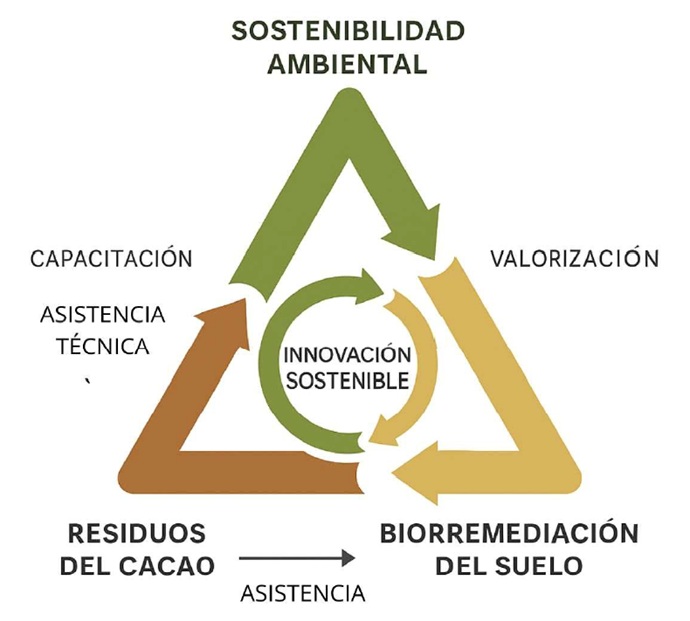
The inadequate management of cocoa residues represents a constraint to agricultural sustainability and a potential source of soil contamination in productive ecosystems. Their biotechnological valorization emerges as a viable alternative to strengthen the circular economy and promote the recovery of degraded soils. This study aimed to analyze the management and valorization practices of cocoa residues in Los Ríos Province, Ecuador, assess their relationship with environmental indicators associated with the Sustainable Development Goals (SDGs 6, 12, 13, and 15), and propose a circular management model with a sustainable innovation approach. The research followed a quantitative, non-experimental, descriptive, and correlational design, applying structured surveys to 371 producers selected through stratified probabilistic sampling. Descriptive analyses, Spearman correlations, and principal component analysis were conducted. The results showed that 39% of producers reuse cocoa residues as organic fertilizer, whereas 33% dispose of them without treatment. The knowledge and sustainable innovation index was low (1.96), and the global environmental sustainability index reached a medium value (2.8). Significant negative correlations were identified between inadequate waste disposal and environmental indicators (ρ = -0.518 to -0.375; p < 0.001), whereas positive associations were found between knowledge and sustainable innovation and SDGs 6, 12, and 15 (ρ = 0.316 to 0.415; p < 0.001). Principal component analysis revealed three dimensions explaining 75.4% of the total variance: sustainable practices and resource management, technical knowledge and innovation, and environmental conservation. Overall, the findings support a circular management model based on the biotechnological valorization of cocoa residues as an ef fective strategy to enhance productive sustainability and restore the functionality of agricultural soils.
Downloads