Análisis del Proceso Hidrológico de Microcuencas Forestales Pareadas y Evaluación del Efecto del Establecimiento de Presas en Cauces y Cárcavas
DOI:
https://doi.org/10.28940/terralatinoamericana.v44i.2277Palabras clave:
escurrimiento, hidrograma, precipitación, regresión múltipleResumen
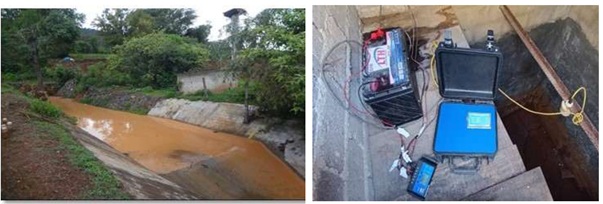
Las microcuencas forestales pareadas instrumentadas permiten obtener variables de lluvia y escurrimiento para evaluar la respuesta hidrológica y determinar el efecto de presas en cauces y cárcavas. Se evaluó la respuesta hidrológica de dos microcuencas forestales pareadas de la cuenca del Lago de Pátzcuaro: la microcuenca Ichupio en la que se establecieron presas en cauces y cárcavas y la microcuenca Malacate que se usó como “testigo”. Las microcuencas se instrumentaron con pluviómetros digitales para registrar la lluvia y con vertedores de garganta larga con sensores ultrasónicos para registrar el gasto. Mediante una regresión lineal y múltiple, se analizaron 11 variables de precipitación y escurrimiento para identificar su influencia en la respuesta hidrológica de las microcuencas. Se analizaron 13 eventos en pares que presentaron escurrimiento superficial simultáneamente en las microcuencas. El análisis del proceso hidrológico muestra, que la microcuenca Malacate presenta mayores magnitudes de escurrimiento (volumen, lámina, coeficiente, máximo y medio) aun cuando ambas microcuencas presentaron similares cantidades e intensidades de lluvia. Los factores determinantes para que se presente el escurrimiento, en ambas microcuencas, fueron la precipitación total del evento (PTE), la precipitación previa de 2 días (PP2D), la intensidad de la precipitación en 30 minutos (IP30) y el tiempo de escurrimiento (TESC). Cada microcuenca mostró respuestas distintas en las variables de escurrimiento por efecto de las presas en cauces y cárcavas. Existen vínculos entre las obras de conservación del agua y del suelo y las respuestas hidrológicas en la microcuenca Ichupio en términos de escurrimiento directo y descarga máxima. Se observaron diferencias significativas en los gastos e hidrogramas, aun cuando las condiciones de las precipitaciones fueron similares en ambas microcuencas. Los resultados mostraron que la magnitud del escurrimiento depende de la interacción entre las precipitaciones, la cubierta forestal y el establecimiento de presas en cauces y cárcavas.
Descargas
Publication Facts
Reviewer profiles N/D
Author statements
- Editor & editorial board
- profiles
- Academic society
- Terra Latinoamericana

Para obtener más información sobre un dato, haga clic

PF is maintained by the Public Knowledge Project
Citas
Andréassian, V. (2004). Water and forests: from historical controversy to scientific debate. Journal of Hydrology, 291, 1–27. https://doi.org/10.1016/j.jhydrol.2003.12.015
Andréassian, V., Lerat, J., Le Moine, N., & Perrin, C. (2012). Neighbors: Nature´s own hydrological models. Journal of Hydrology, 414, 49–58. https://doi.org/10.1016/j.jhydrol.2011.10.007
Atalar, F., Beyazoglu, O., Fernald, A. G., Burney, O. T., VanLeeuwen D. M., & Cram, D. S. (2021). A case study of runoff and sediment yield in areas subjected to different forest thinning operations in a northern New Mexico forest. Journal of Soil and Water Conservation, 76 (4), 293-302. https://doi.org/10.2489/jswc.2021.00135
Bosch, J., & Hewlett, J. (1982). A review of catchment experiments to determine the effect of vegetation changes on water yield and evapotranspiration. Journal of Hydrology, 55 (1–4), 3–23. https://doi.org/10.1016/0022-1694(82)90117-2
Brown, A.E., Zhang, L., McMahon, T.A., Western, A.W., & Vertessy, R.A., (2005). A review of paired catchment studies for determining changes in water yield resulting from alterations in vegetation. Journal of Hydrology, 310 (1–4), 28–61. https://doi.org/10.1016/j.jhydrol.2004.12.010
Clausen, J. C., & Spooner, J. (1993). Paired Watershed Study Design. Office of Wetlands, Oceans and Watersheds. Environmental Protection Agency. Washington DC.
Chang, Y., Liu, X. Cao, B. Wang, Y., & Shen, Y. (2024). Effects of vegetation restoration on runoff and its components in the mountainous Haihe River Basin. Journal of Hydrology, Regional Studies 53. 101803. https://doi.org/10.1016/j.ejrh.2024.101803
Chow, L., Xing, Z., Benoy, G., Rees H.W., Meng F., Jiang Y., & Daigle, J. L. (2011). Hydrology and water quality across gradients of agricultural intensity in the Little River watershed area, New Brunswick, Canada. Journal of Soil and Water Conservation, 66 (1), 71-84. https://doi.org/10.2489/jswc.66.1.71.
Cosandey, C., Andreassian, V., Martin, C., Didon-Lescot, JF., Lavabre, J., Folton, N., Mathys, N., & Richard, D. (2005). The hydrological impact of the mediterranean forest: a review of French research. Journal of Hydrology, 301: 1-15. https://doi.org/10.1016/j.jhydrol.2004.06.040
Çtgez, T., Karagül, R., & Özcan, M. (2021). Evaluation of the effects of some watershed characteristics on water and suspended sediment yield in agricultural and forest dominated watersheds. Šumarski list, 145 (5-6), 249-260. https://doi.org/10.31298/sl.145.5-6.4
Goeking, S., & Tarboton, D. (2020). Forests and Water Yield: A Synthesis of Disturbance Effects on Streamflow and Snowpack in Western Coniferous Forests. Journal of Forestry, 118 (2), 172–192. https://doi.org/10.1093/jofore/fvz069
Hibbert, A. (1967). Forest treatment effects on water yield. P. 527–543 in International symposium on forest hydrology, Sopper, W.A.L.H. (ed.). Pergamon, Oxford.
Kang, T., & Sharma, A. (2024). A state-controlled hypothesis test for paired-watershed experiments. Journal of Hydrology, 640, 131664. https://doi.org/10.1016/j.jhydrol.2024.131664
King, K.W., Smiley, P.C., Baker, B.J., & Fausey N.R. (2008). Validation of paired watersheds for assessing conservation practices in the Upper Big Walnut Creek watershed, Ohio. Journal of Soil and Water Conservation, 63 (6), 380-395. https://doi:10.2489/jswc.63.6.380.
Lacombe, G., Ribolzi, O., Rouw, A.D., Pierret, A., Latsachak, K., Silvera, N., Dinh, R.P., Orange, D., Janeau, J., Soulileuth, B., Robain, H., Taccoen, A., Sengphaathith, P., Mouche, E., Sengtaheuanghoung, O., Duc, T.T., & Valentin, C. (2016). Contradictory hydrological impacts of afforestation in the humid tropics evidenced by long-term field monitoring and simulation modelling. Hydrology and Earth System Sciences, 20 (7), 2691–2704. https://doi.org/10.5194/hess-20-2691-2016
Latron, J., & Gallart, F. (2008). Runoff generation processes in a small Mediterranean research catchment (Vallcebre, Eastern Pyrenees). Journal of Hydrology, 358 (3-4), 206-220. https://doi.org/10.1016/j.jhydrol.2008.06.014
Li, Q., Wei, X., Zhang, M., Liu, W., Fan, H., Zhou, G., Giles-Hansen, K., Liu, S., & Wang, Y. (2017). Forest cover change and water yield in large forested watersheds: A global synthetic assessment: Forest cover change and annual water yield variations. Ecohydrology, 10, 10.1002/eco.1838. https://doi.org/10.1002/eco.1838
Martínez Fernández, J., Ceballos Barbancho, A., Hernández Santana, V., Casado Ledesma, S., & Morán Tejeda, C. (2005). Procesos hidrológicos en una cuenca forestal del Sistema Central: Cuenca Experimental de Rinconada. Cuadernos de Investigación Geográfica, 31, 7–25. https://doi.org/10.18172/cig.1171
Ogden, F., & Dawdy, D. (2003). Peak Discharge Scaling in Small Hortonian Watershed. Journal of Hydrologic Engineering, 8 (2), 64-73. https://doi.org/10.1061/(ASCE)1084-0699(2003)8:2(64)
Pérez, H. C. D. (2017). Efectos acumulativos en la microcuenca La Joya: Evaluación de obras y prácticas de conservación. Tesis de Maestría en Ciencias. Universidad Autónoma de Querétaro. Facultad de Ciencias Naturales. Querétaro, Qro. 102 pp. http://ri-ng.uaq.mx/handle/123456789/1578
Richardson P. W., Cafferata P. H., Dymond S. F., Keppeler E. T., Wagenbrenner J. W., & Whiting J. A. (2023). Past and future roles of paired watersheds: a North American inventory and anecdotes from the Caspar Creek Experimental Watersheds. Frontiers in Forests and Global Change, 6:1275392. https://doi.org/10.3389/ffgc.2023.1275392
Serrano, M. M. O., Regües, D., Latrón, J., Martí, N. C., Lana-Renault, N., & Nadal, R. E. (2005). Respuesta hidrológica de una cuenca forestal en la montaña media pirenaica: el caso de San Salvador. Cuaderno de Investigación Geográfica, 31, 59-76. Universidad de La Rioja. https://dialnet.unirioja.es/servlet/articulo?codigo=1975902
Serrano-Muela, M. P., Lana-Renault, N., Nadal-Romero, E., Regüés, D., Latron, J., Martí-Bono, C., & García-Ruiz, J. M. (2008). Forests and their hydrological effects in Mediterranean Mountains. Mountain Research and Development, 28 (3), 279-285. http://doi.org/10.1659/mrd.0876
Shi, C., Yuan, S., Shi, C., & Zhao, T. (2018). Estimating the Effect of Precipitation and Vegetation on Water Yield in Northern China. Polish Journal of Environmental Studies, 27(1), 305-311. https://doi.org/10.15244/pjoes/75814
Siriwardena, L., Finlayson, B., & McMahon, T., (2006). The impact of land use change on catchment hydrology in large catchments: The Comet River. Journal of Hydrology, 326 (1–4), 199–214. https://doi.org/10.1016/j.jhydrol.2005.10.030
Sriwongsitanon, N., & Taesombat, W. (2011). Effects of land cover on runoff coefficient. Journal of Hydrology, 410, 226–238. https://doi.org/10.1016/j.jhydrol.2011.09.021
Suryatmojo, H., Masamitsu, F., Kosugi, K., & Mizuyama, T. (2013). Effects of Selective Logging Methods on Runoff Characteristics in Paired Small Headwater Catchment. Procedia Environmental Sciences, 17, 221-229. https://doi.org/10qosmiox505.1016/j.proenv.2013.02.032
Suryatmojo, H., Fujimoto, M., Kosugi, K., & Mizuyama, T. (2014). Runoff and soil erosion characteristics in different periods of an intensive forest management system in a tropical Indonesian rainforest. International Journal of Sustainable Development and Planning, 9 (6), 830–846. https://doi.org/10.2495/SDP-V9-N6-830–846
Suryatmojo, H. (2015). Rainfall-runoff investigation of pine forest plantation in theupstream area of Gajah Mungkur reservoir. Procedia Environmental Sciences, 28, 307 – 314. https://doi: 10.1016/j.proenv.2015.07.039
Van Loon, A.F., Rangecroft, S., Coxon, G., Breña, N. J. A., Ogtrop, F. V., & Van Lenen, H. A. (2019). Using paired catchments to quantify the human influence on hydrological droughts. Hydrology and Earth System Sciences, 23 (3), 1725–1739. https://doi.org/10.5194/hess-23-1725-2019
Vose, J.M., Sun, G., Ford, C.R., Bredemeier, M., Otsuki, K., Wei, X., Zhang, Z., & Zhang, L. (2011). Forest ecohydrological research in the 21st century: what are the critical needs?. Ecohydrology 4 (2), 146–158. https://doi.org/10.1002/eco.193
Wei, X., & Zhang, M. (2010). Quantifying streamflow change caused by forest disturbance at a large spatial scale: a single watershed study. Water Resources Research, 46 (12), W12525. https://doi.org/10.1029/2010WR009250
Zhang, M., & Wei, X. (2014). Contrasted hydrological responses to forest harvesting in two large neighboring watersheds in snow hydrology dominant environment: implications for forest management and future forest hydrology studies. Hydrological Processes, 26, 6183-6195. http://dx.doi.org/10.1002/hyp.10107.
Zhang, M., Liu, N., Harper, R., Li, Q., Liu, K., Wei, X., Ning, D., Hou, Y., & Liu, S. (2017). A global review on hydrological responses to forest change across multiple spatial scales: Importance of scale, climate, forest type and hydrological regime. Journal of Hydrology, 546, 44–59. https://doi.org/10.1016/j.jhydrol.2016.12.040